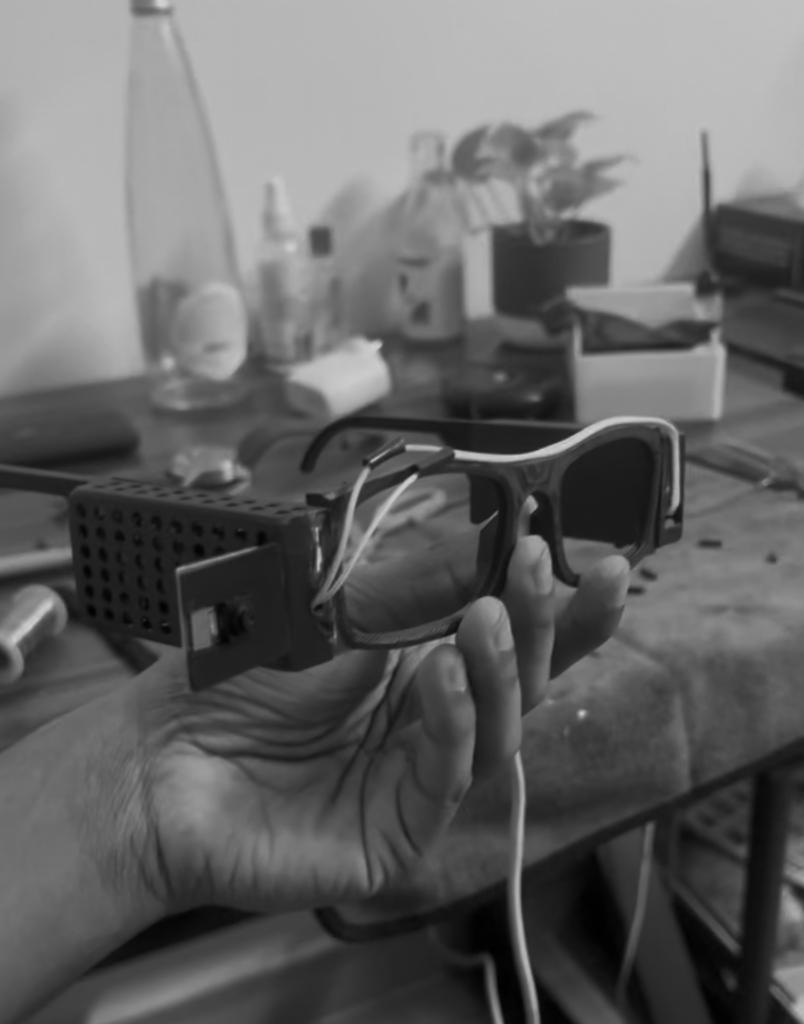
be.glasses are a tool that helps blind/partially visually impaired individuals lead an independent life. Imagine if a person could identify objects in their day-to-day life and understand the value of currency notes. That creates a profound impact. Built by me in 1st semester of ECE Engineering.
The camera captures visual data, which is processed by the Raspberry Pi using computer vision algorithms (Efficient DET & custom ML models). Pytesseract and Google Vision handle Optical Character Recognition (OCR) to extract text.
Controlled entirely via voice commands using Speech Recognition. The results are converted to audio using Text-to-Speech (TTS) algorithms and played through a Bluetooth headset.
Provides audio descriptions of over 100+ real world objects, making it incredibly useful for day-to-day object recognition, social interaction, and safety.
Enabled by a human presence detection algorithm, it alerts the user if a human enters or is present in the same room, potentially saving the individual wearing the device in emergencies.
Since most public spaces are not designed with visually impaired individuals in mind, the text extraction algorithm drastically improves the overall public experience, fostering societal inclusion.
Analyzes facial expressions in real-time to detect basic human emotions, helping users better read social cues and vastly enhancing interpersonal communication.
As we wrap up, we’ve designed detailed 3D models for the glasses, sourced core electronics, and significantly progressed our software for object detection and navigation algorithms.
“Together, we’re not just building glasses; we’re building independence.”